Phase Three Leadership: The Wilderness & Oasis of Utopia
Jan 16, 2026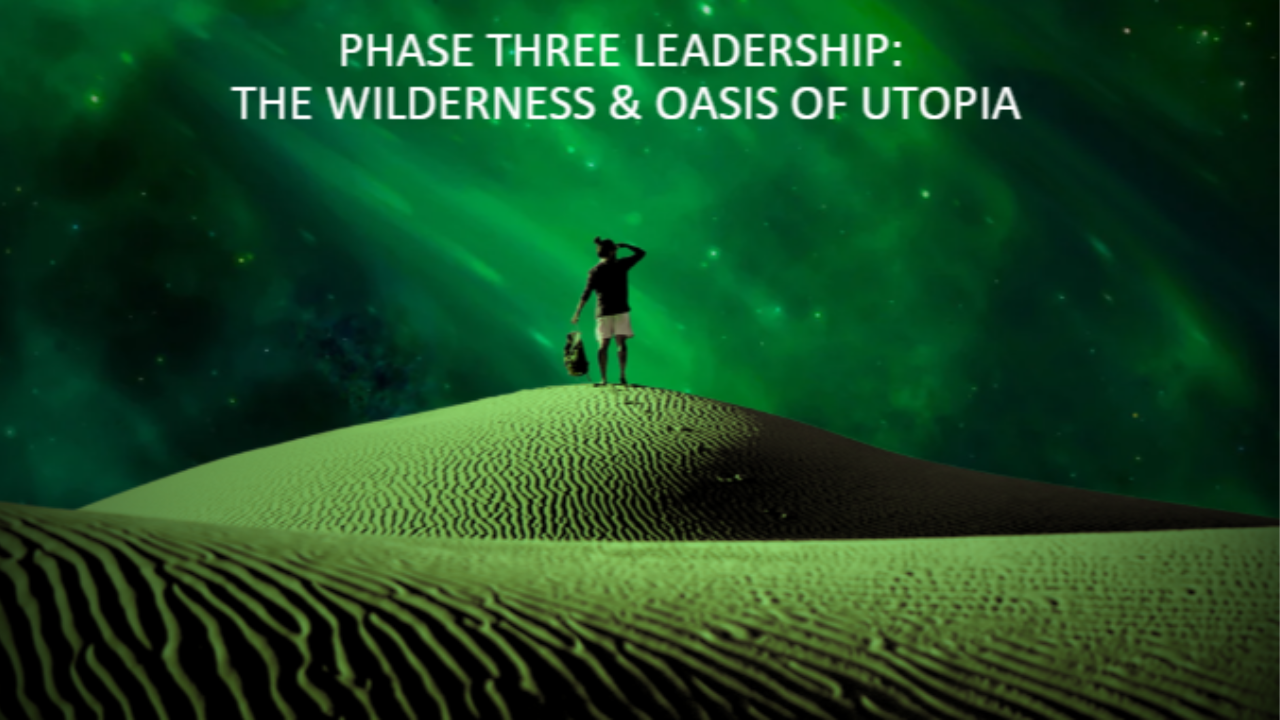
As decades in senior leadership executive life pass by, seemingly all too quickly, generally from the age of 59 and beyond, they enter what I define as Phase Three. This is not simply a career stage; it is a profound transition in identity. It can hit when least expected; however, the drive that once fuelled ambition, recognition, and achievement begins to evolve to reflection, evaluation, and renewal. This is a time when ecosystems, once vast and complex, start to shift in several dimensions and demand reconfiguration.
I refer to it as The Wilderness and Oasis of Utopia: a landscape filled with paradoxes. It can feel like freedom and loss, clarity and confusion, solitude and peace, all at once. The wilderness represents the letting go, the stripping back of what no longer serves. The oasis is the rediscovery of the six foundational pillars with a deeper philosophical and spiritual perspective of self-worth, readjustment of purpose, and identity when the noise quietens, and introspection deepens.
The Wilderness: When the Familiar Starts to Change
After decades of leadership, the world begins to look different. The familiar urgency of tension, deadlines, politics, meetings, barriers to navigate, and crises starts to take a different shape and toll, and with it, the adrenaline that once defined momentum. Many leaders find this disorienting. The structures that anchored daily life, teams, routines, recognition, and constant connection also begin to shift. Children become independent, families change shape, colleagues retire or move on, leadership teams evolve, technology is reshaping business, and organisations evolve around you.
Phase Three is therefore a period of ecosystem loss and renewal. The networks built over decades now require review: which relationships remain meaningful, and which are simply residue of former roles? The drive to accumulate many connections gives way to a desire for clarity, simplification, and transparency, illuminating the next pathway.
For many, this is an unsettling experience. The sense of self that was reified in great influence and visibility can become at times unsettling and waver. Leaders may find themselves questioning not only what they do, but who they are, in particular from so many years sitting at the top overseeing what they have helped build beyond expectation, fighting so hard over the years to remain resilient, successful, and relevant for their people within the organisation. However, it is not uncommon to experience what I call ecosystem displacement, a feeling of being between worlds, unsure where you now want to fit.
Yet within this uncertainty lies immense potential. The wilderness is not a time for internal punishment; it is preparation. It forces a wonderful confrontation with long-ignored questions:
• What remains essential to my purpose?
• What has been lost in pursuit of achievement?
• What kind of leader do I wish to be now, when I no longer feel the need to prove myself?
Confrontation of Contradictions
Phase Three is filled with a dichotomy of choices, wishes, and uncertainty. Leaders want legacy, but they also crave peace. They seek relevance, yet long for longer rest opportunities. They desire connection but increasingly value solitude. They seek new experiences yet have so much knowledge and wisdom from their chosen field. They want reconnection to self that can require removing barriers long been in place, but used as convenient excuses not to focus on themselves.
These dichotomies are not signs of confusion; they are indicators of evolution. The mind and heart are recalibrating, seeking equilibrium between doing and being. After years of leading at full velocity, Phase Three warrants a more considered and more reflective form of leadership, one that draws on wisdom, not speed.
This period also tests identity ownership. For decades, many leaders title, status, results, and influence have helped define them. Now, they must rediscover the person beneath the professional, the individual whose worth does not depend on output or recognition.
It is also a time when the emotional, psychological, and spiritual costs of Phase Two, fatigue/burnout, strained relationships, and physical and mental health sacrifices may surface. The evolution to reclaim full discovery and turn the mirror fully inward can require brutal honesty that has possibly been avoided until now: confronting regrets, guilt, acknowledging the human toll of success, and making peace with what cannot be changed. It is vital to understand that this stage is not one of weakness. It is maturity to face this new trepidation of vulnerability with quiet enthusiasm for the enlightenment that can be forthcoming.
Reconnecting with the Pillars: Returning to the Core
In Phase One, we spoke of the six foundational pillars: sleep, exercise, nutrition, rest/quiet time, environment, and community. By Phase Three, these pillars often require full restoration. They have long been sacrificed and weathered decades of strain, adaptation, and compromise.
Leaders in this phase begin to notice the cost of neglect. Health becomes a daily consideration rather than an afterthought. Sleep, once optional, becomes vital. Movement and nutrition shift from performance enhancers to lifelines. Quiet time, once rare, becomes sacred.
But perhaps the most profound pillar in this phase is community. There is a confronting and stark realisation that time is our most important commodity; however, it is not infinite, and we spent an incredible amount to build large networks in earlier decades. But now we want these to contract to what is essential, meaningful, and genuine. The noise of hundreds of contacts narrows to a few deep, trusted relationships that nourish rather than drain that most rare commodity of unknown length. This essential pruning process, removing social and professional clutter, is essential to mental, spiritual, physical, and emotional wellbeing.
It is in this rebalancing that leaders rediscover presence, being where their feet are fully in the moment rather than anticipating the next one. The 3P-S Lab framework—Purpose, Presence, Present, and Situational Specific leadership, proves invaluable here. It offers a lens to reinterpret experience, not through performance but through meaning.
Wisdom as the New Currency
By Phase Three, leaders possess something rare: decades of lived experience, tempered by adversity, reflection, and recovery. This experience becomes their most valuable contribution, not as a directive force, but as a guiding light.
The front-end leadership skills developed across Phases One and Two, emotional intelligence, liminal perspective, the pause button, ethical radar, and situational awareness, now mature into something more profound: discernment.
Discernment is the ability to read complexity without rushing to solve it; to listen without needing to respond; to sense when to engage and when to step back. It is wisdom operationalised.
Phase Three leaders are not simply older versions of their former selves. They are repositories of knowledge that younger leaders desperately need but often do not know how to access. This is where the leadership ecosystem becomes generational. The Phase Three leader’s role evolves from driver to cultivator, from commanding outcomes to nurturing growth in others.
They become the steady presence in the storm, the calm voice of reason, the person who can bring safety and focus to the room, simply by saying, “I’ve seen and experienced things similar to this many times before; here’s what matters right now.”
The Wilderness Decisions: Redefining Leadership Beyond the Pressure Cooker
For many entering Phase Three, there comes a quiet yet profound crossroads. Having spent decades at the centre of high-stakes decision-making, crisis navigation, tension, and situational influence, leaders begin to question whether continued immersion in the pressure cooker of senior leadership still aligns with their evolving sense of purpose, health, and values. The wilderness invites deep reflection, not as an ending, but as an evolution of leadership identity.
This is a moment to consider what the next expression and evolution of their decades of leadership could become. The question is no longer “What am I leading?” but rather, “Where can my experience create the greatest value now?”
For some, this means stepping back from executive roles and transitioning toward governance, board leadership, or strategic advisory work, positions that require not a relentless presence, but the seasoned judgment earned through decades of complexity. Governance roles demand a different kind of leadership intelligence: the ability to read ethical signals, balance stakeholder ecosystems, and guide without dominating. Here, emotional intelligence and the liminal perspective become critical assets. The experienced leader evolves into the quiet calibrator, the conduit between stakeholders, the connector, and the person who can hold contradictions in tension, sense imbalance early, and steer organisations with composure rather than urgency.
Others find renewal in consulting or selective mentoring, offering guidance to those in Phases One and Two who are still building resilience under pressure. These leaders no longer compete for space; they create it for others to grow, reflect, and learn. Their conversations shift from performance metrics to purpose, from visibility to meaning.
And for many, this phase also reopens doors long closed: hobbies, travel, and pursuits once shelved under the weight of responsibility. The wilderness, then, becomes not isolation but freedom, a space to rediscover curiosity, creativity, and self. This rediscovery is not self-indulgence; it is self-healing in many ways and the restoration of the six pillars. It is the rebalancing of ecosystems and the reaffirmation with greater depth of identity beyond the title or the boardroom.
Phase Three leaders often describe this as a paradoxical liberation: a conscious deceleration that brings sharper clarity. With the scaffolding of the 3P-S Lab, Purpose, Presence, Present, and Situational Specific leadership, they can integrate decades of learning into a new mode of influence: deliberate, composed, and generative. This is the moment where wisdom becomes strategy, not through control but through counsel.
The wilderness decisions of Phase Three are not about withdrawal; they are about redefinition. They ask:
• What remains essential to my purpose?
• Where does my contribution now hold the greatest value?
• What parts of my ecosystem still nourish me, and which have become clutter?
When answered honestly, these questions open the pathway to the oasis of Utopia, a life where leadership is no longer measured by scale or speed, but by resonance, alignment, and legacy.
From Wilderness to Oasis: The Final Evolution
When navigated with intention, Phase Three becomes the most rewarding of all. The wilderness is not a place to be feared; it is a proving ground for renewal. The oasis that follows is not a destination but a state of being, where peace and purpose finally converge.
Leaders who find this balance often describe an unprecedented sense of coherence. They are no longer fragmented by competing demands but whole, aligned, and free. Their presence carries quiet confidence well earned, with the inner scars of leadership healed with sage lessons to share, and their decisions deep with values of moral clarity. They have nothing left to prove, only something to give.
In this final evolution, legacy ceases to be about what is left behind and becomes about what continues to evolve and the wonderful gifts that they have weaved into everyone they have touched throughout their journey with others, the leaders they mentor, the organisations they shape, the lives they steady.
Phase Three, then, is not the end of leadership. It is leadership, refined to its purest form.